I build language-technology software end to end, from retrieval pipelines and LLM agents
to the web apps and APIs people actually use. I am finishing my MSc in
Computational Linguistics and Language Technology
at the University of Zurich
(minor in Neuroinformatics), after a BEng in Materials Science and Engineering at
Huazhong University of Science and Technology.
I am co-first author of Co-DETECT (EMNLP 2025 System
Demonstrations), and in my own projects I build agentic LLM systems,
spending most of my effort on what makes them trustworthy: deterministic guardrails around
the model, measurable evaluation, and traces that explain every answer.
I am looking for a full-time position as an AI Engineer or
Software Engineer, based in Zurich and happy to relocate within Europe,
and can start immediately. If that sounds like a fit, reach me on
LinkedIn.
Experience
Student Research Assistant
Oct 2025 – Present
Department of Finance, University of Zurich, Zurich
Research on reading inflation expectations and monetary policy from text, continuing my master's thesis.
Built a Python NLP pipeline that turns 3.46 million Financial Times articles into monthly U.S. inflation-forecasting features, weighting articles by U.S. relevance with spaCy NER and comparing LDA, NMF and BERTopic.
Evaluated LASSO, ElasticNet, PLS and random-forest forecasters 3 to 12 months ahead in expanding-window out-of-sample backtests against AR and Fed Greenbook baselines, with per-fold scaling and no look-ahead leakage.
Fine-tuned RoBERTa-large for FOMC policy-stance classification, matching a QLoRA-tuned Qwen2.5-7B on macro-F1 (66.2% vs. 66.8%; Qwen zero-shot 47.4%) with 75% less inference memory and 8× faster inference.
Served the pipeline as an asynchronous FastAPI service with a React dashboard, containerized with Docker on AWS EC2.
Full Stack Software Engineer Intern
Jun 2025 – Oct 2025
Your Applicant AG, Zurich
An early-stage startup building a two-sided recruitment marketplace in TypeScript, React/Next.js, Node.js/Express and Prisma/PostgreSQL.
Built core features, implementing the job, work-session and payment lifecycles as state machines.
Integrated Stripe pay-ins with Wise payouts, using payment UUIDs as idempotency keys so no payout goes out twice, and atomic status-conditional updates to keep payment states consistent across the API, cron jobs and webhooks.
Kept quotes and charges consistent with one calculation module shared by client and server, in integer minor units, with Jest regression tests for rounding, refunds and duplicate webhooks.
Implemented server-side role-based access control on Supabase Auth, verifying JWTs and record ownership before payment, payout and dispute operations.
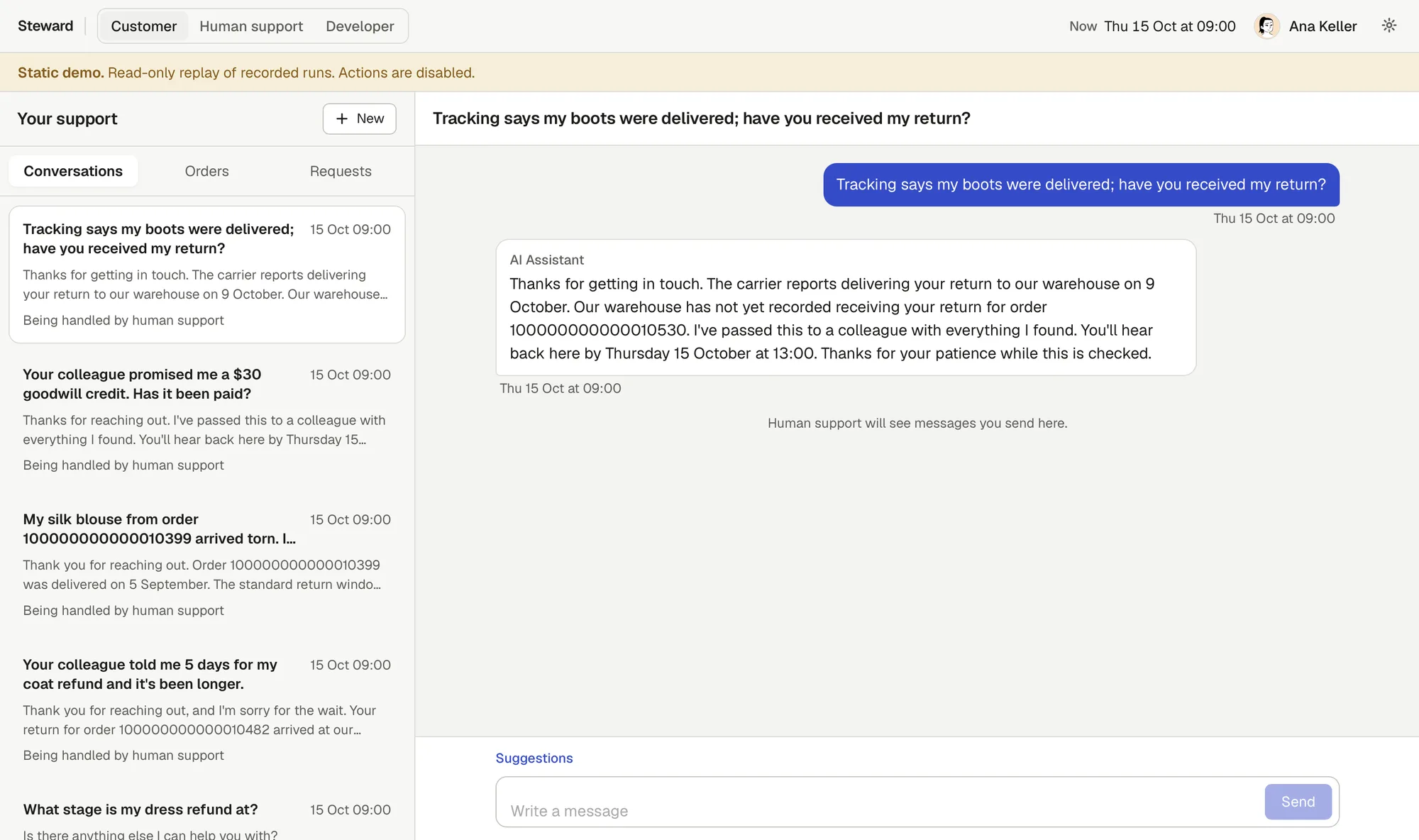
An after-sales support desk for an online store, where an AI agent answers customers first and human reps work the same cases. The model understands and words; code decides what is allowed.
88.3%
rubric pass rate, vs. 68.3% agent-only
~50%
lower model cost, 5.9 s vs. 17.3 s median latency
0
duplicate tasks in 120 fault-injection runs
0
disagreements with τ²-bench tools over 25,057 cases
Steward is one system for the agent and the support team. A customer chats with the agent; anything that needs a decision goes to a rep with the evidence attached. Reps get an inbox, a case view with proposal timelines and evidence packs, and customer pages showing return terms per order line. Customer claims, staff statements, authorized promises and their fulfilment are kept apart and linked to their sources, so a customer can pick a request up in a new conversation and a rep sees the whole case at a glance.
Most support messages fall into a handful of intents, so the model does not improvise. One LLM call classifies the intent and extracts the details; plain code then routes to policy retrieval, a fixed case workflow, or a bounded tool-calling investigation (in the development run, only 5 of 20 requests needed it). Eligibility, amounts and write preconditions are always computed in code. Against an agent-only baseline on the same 20 cases, this passed 88.3% of 120 trials versus 68.3%, at about half the model cost.
Writes that touch money need staff authorization and, for the customer's own account, the customer's consent, both bound to the exact arguments. Approvals are tied to a version of the case, executions carry idempotency keys, and an outcome that comes back unknown is reconciled rather than retried. Across 120 injected-fault runs (lost responses, unavailable lookups, crashes, timeouts), none produced a duplicate task. I also checked the write rules against τ²-bench retail's native tools on 25,057 generated cases, with no disagreements.
What the agent said is not what the store promised: goodwill credits live in an append-only ledger that only the action layer writes. Policies that differ only in numbers are separated by effective date, which cut wrong-version top-1 retrieval from 33% to 0% over 247 questions. Every evaluation case can be replayed, with hashed inputs, source snapshots and linked OpenTelemetry/Langfuse traces; those traces are how I found a multi-turn parsing bug that kept the agent asking the same eligibility question.
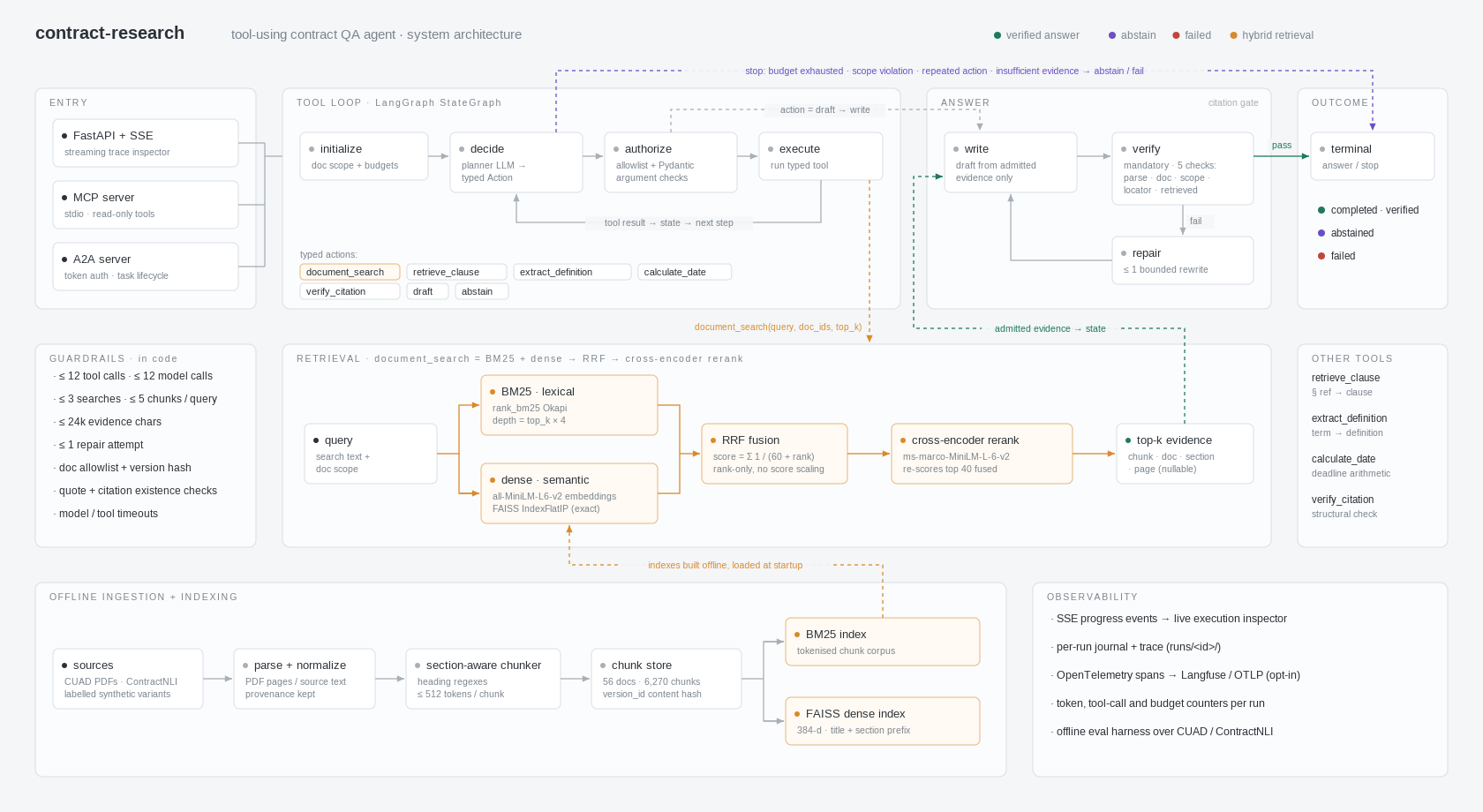
Contract questions usually hinge on one clause, a defined term, or a deadline counted in calendar days. The agent, built on LangGraph, handles them with schema-validated tool calls that retrieve clauses, look up definitions and do the date arithmetic, so the model reasons over evidence rather than memory.
Retrieval was the hard part. Combining BM25 with FAISS dense search, expanding queries with contract terminology and reranking with a cross-encoder lifted evidence recall@5 from 45.8% to 72.7% on a 36-question development set.
Citations are checked against what was actually retrieved, each question is scoped to one document and version, and every run has an execution budget. Regression tests cover unanswerable questions, conflicting contract versions and prompt injection. The tools are exposed through an MCP server, the agent through an authenticated A2A endpoint, and runs can be watched live over FastAPI and server-sent events.
Research project at ETH Zürich, EMNLP 2025 Demo, co-first author
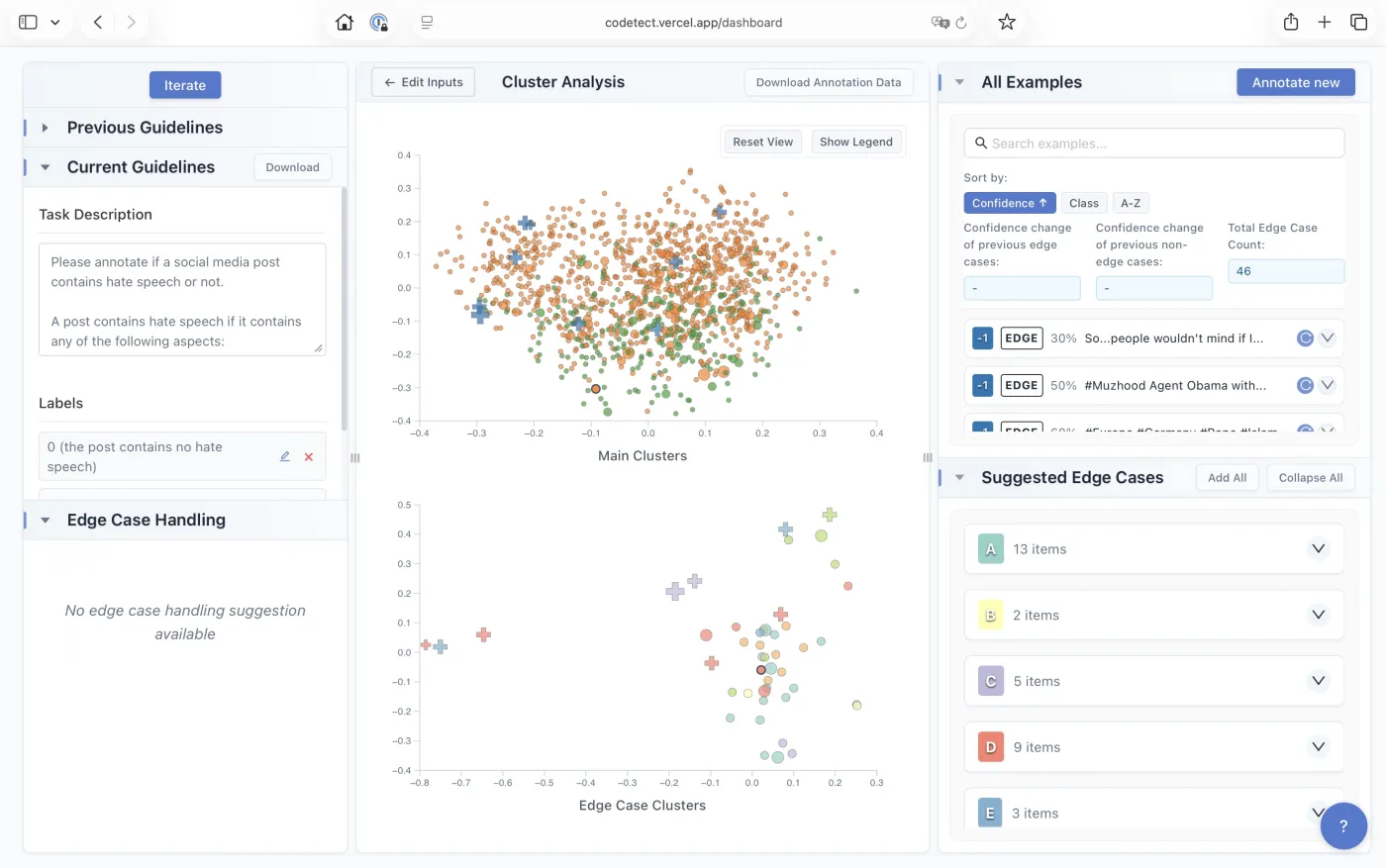
A human-in-the-loop annotation tool: an LLM labels a corpus and surfaces the edge cases the codebook does not cover, and the domain expert decides which handling rules go into the next version. I built the interface.
0.03 → 0.33
GPT-4.1 F1 on GoEmotions-positive after one codebook iteration
33 / 41
sampled texts well described by their edge-case cluster
9 / 10
expert users expect it to find edge cases they did not know
Social scientists annotate text against a codebook, a task definition with labels written by a domain expert. A codebook is drafted before anyone has read most of the data, so it misses edge cases, and experts find it hard to put their intuitions into rules. Co-DETECT lets the LLM do the reading and the expert do the judging. The expert enters a sketch-level codebook and 500 to 1,000 texts. GPT-4.1 labels every text, reports its confidence, and for uncertain ones proposes a rule of the form "when [case], do [action]". The backend embeds these item-level cases, groups them with size-constrained KMeans, and has DeepSeek-R1 summarize each group into a general edge case with a handling rule, merging overlaps so similar cases get one rule.
The dashboard I built answers the question an expert actually asks: where does my codebook break, and why? Its centre is two linked D3.js scatter plots. The upper one shows every annotated text, placed by embedding similarity, coloured by label and sized by uncertainty, so doubtful annotations stand out at a glance. Clicking a point opens the LLM's reasoning and confidence; following an uncertain one leads into the lower plot of edge-case clusters, shown beside the system's description of each cluster and its member texts. The expert checks a suggestion against real examples instead of trusting a summary, which in our study took under five seconds per text.
The expert stays in charge of the codebook. A suggested edge case they agree with goes into an Edge Case Handling panel, where its rule can be edited; one click on Iterate re-annotates the corpus with the extended codebook, and earlier versions are kept alongside. Each round the model proposes and the human decides. In a study with 10 domain experts, 80% found the workflow easy to follow, and appending the accepted rules alone raised GPT-4.1's F1 on all three subjective datasets we tested.
A microservice platform for creating and joining events, built in Java with Spring.
Java, Spring Boot, Spring Cloud Gateway, PostgreSQL, Docker, GitHub Actions
How it works
REST services for users, events and social content sit behind a Spring Cloud Gateway with Eureka service discovery, store their data in PostgreSQL, and start with a single Docker Compose command. GitHub Actions runs the test suite on every pull request.
Two parts got the most care. Protected changes need a valid JWT plus the right role or ownership, and integration tests confirm that missing, expired or tampered tokens, or another user's token, change nothing. Registration stays correct under load: a database uniqueness constraint and atomic conflict handling mean parallel requests yield at most one registration per user and event, which concurrency tests check.
Open-source customizable spell-checking tool with real-time feedback using custom Hunspell dictionaries. Built for linguists and NLP researchers.
Django, React, TypeScript, PostgreSQL, Docker
Education
University of Zurich
2022 – 2026
MSc in Computational Linguistics and Language Technology, minor in Neuroinformatics
Master's thesis, grade 6.0 / 6.0:Measuring Inflation Expectations through Narrative Analysis of Financial News
Selected coursework
LLMs & NLP
Large Language Models, Retrieval-Augmented Generation, Advanced Techniques of Machine Translation, IBM watsonx Agentic AI Challenge
Data science
Foundations of Data Science, Network Science
Software & systems
Software Engineering, Software Construction, Software Engineering Lab, Fundamentals of Software Systems, Computer Networks and Distributed Systems, Web and Mobile Accessibility
Neuroinformatics
Introduction to Neuroinformatics, Systems Neuroscience, Computational Vision
Huazhong University of Science and Technology
2018 – 2022
BEng in Materials Science and Engineering, Wuhan, China
Bachelor's thesis:Viewpoint Generation and Optimization for Robotic Automated 3D Measurement
Publication
Co-DETECT: Collaborative Discovery of Edge Cases in Text Classification
C. Xiong*, J. Ni*, Y. Fan*, V. Zouhar, D. Rooein, L. Calvo-Bartolomé, A. Hoyle, Z. Jin, M. Sachan, M. Leippold, D. Hovy, M. El-Assady, E. Ash (* equal contribution)
Built a conversational skill-gap agent for getAbstract on IBM watsonx Orchestrate. It reads a CV, maps skills to the ESCO taxonomy and runs a short assessment chat to find what to learn next.
MERN 2024 Edition: MongoDB, Express, React and Node.js
Built Jobify, a job-application tracker with JWT login, search and pagination and stats charts, using React, React Router, React Query, Node.js, Express, MongoDB and Mongoose.